
A positive organisational culture benefits a business not only from a legal standpoint but also from a moral, safety, financial and employee satisfaction perspective.
Enables more effective risk management
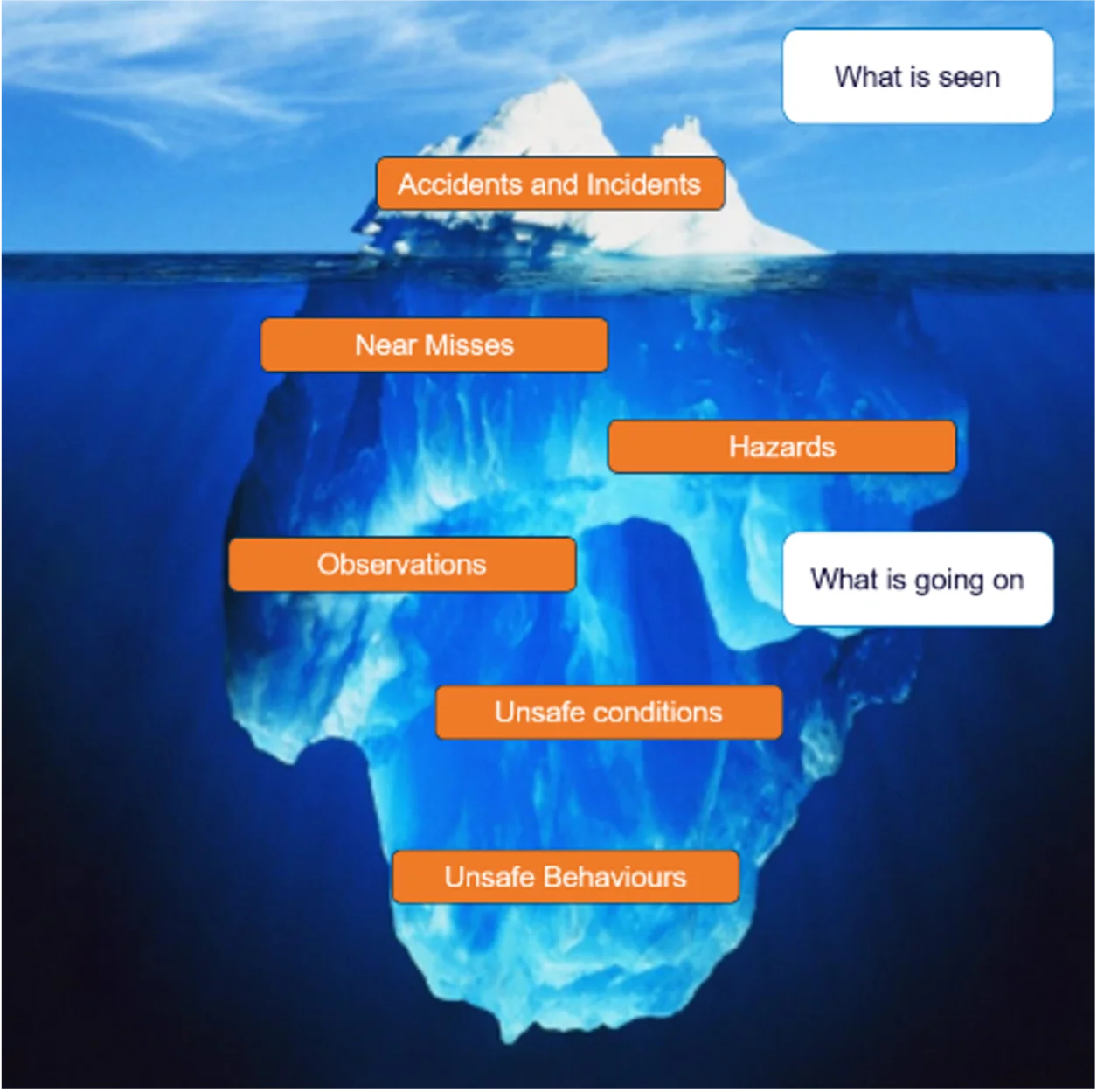
Whilst mandatory occurrences (accidents, incidents and serious events) should always be reported and reviewed so the business can learn from them, it is the voluntary information provided by employees about hazards, near-misses and observations that is vitally important for effective risk management. An iceberg provides a helpful analogy to explain;
What we see above the water line is only a small portion of the entire iceberg structure.
- The accidents, incidents and events above the water line are tangible and immediately noticeable, such as damage to a drone following impact with a structure or the ground, but only represent a small percentage of overall safety issues.
- Reporting these is essential for investigation, learning and corrective actions, although the high number of reporting systems available can feel overwhelming to industry professionals, causing a detrimental impact to proactive reporting.
Beneath the water line there are many near-misses, unsafe conditions and potential hazards or observations.
- These do not always lead to visible accidents but are a warning sign, which if ignored could lead to future incidents.
- Reporting such issues as ‘this nearly happened to me,’ ‘ I saw this today’ etc, along with some form of risk assessment and communication process, will help to identify systemic weaknesses and help to mitigate against future safety related events.
- Proactive hazard identification and assessment (i.e. without reacting to incidents/reports) is also important and helps organisations form a foundation for pre-site/onsite risk assessments and submissions for operational authorisations.
Risk Management Summary
Businesses should be promoting a culture that;
- Encourages employees to take responsibility for safety
- Does not blame employees for making mistakes and errors
- Facilitates free and open feedback and reporting
By doing so, an organisation will be able to identify these ‘hidden risks’. Once identified, these can be mitigated.
A strong safety culture will therefore help to facilitate more effective risk management, irrespective of the size or complexity of the organisation, ultimately driving safer, more efficient operations.
Enhances morale, engagement and productivity
When employees feel valued and their safety is prioritised, morale and engagement tend to increase. They feel more comfortable raising safety concerns and working collaboratively to prevent incidents.
A positive culture promotes engagement, which in turn drives productivity and team cohesion.
Financial and reputational benefit
An accident or incident is expensive. This is not solely due to direct costs resulting from the event, but also due to the costs of reputational damage, which can impact commercial viability in a competitive market.
Companies with a positive safety culture are also seen as more responsible and attractive to both prospective employees and customers.
Compliance
Within the Management System, organisations should have a risk assessment process that enables the business to proactively identify, assess, mitigate and manage risk; not exclusively in response to incidents or occurrence reports.
This process should also complement an organisation’s change management process to better identify the impact to your operation or functional system.
A robust risk assessment process will help organisations form the foundations for pre-site/onsite risk assessments and submissions for operational authorisations.
Summary
It makes good business sense to develop, improve and enhance an organisations safety culture. Without a positive culture, there will be unknown and unmitigated risks, reduced efficiency and potential legal and financial implications. The first step is to assess your safety culture baseline – understanding where you are now is key to improving where you want to be.
Partner with Ebeni
Ebeni stands ready to support you in your journey towards proactive safety management and a positive and engaged safety culture.